

Touch Grass and Grieve

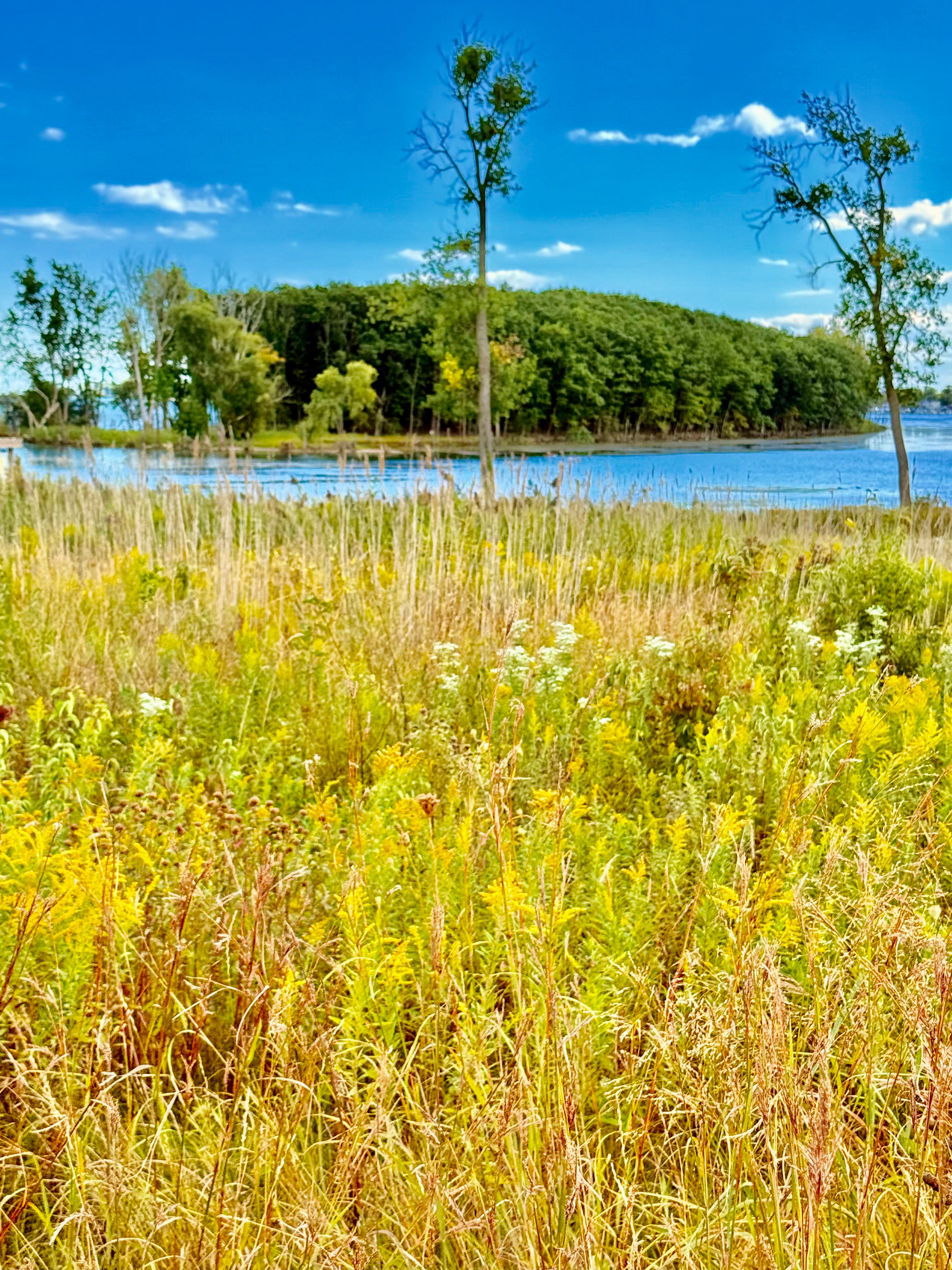
Well, September continues to be an annual month of birth and loss. Life and death. Over the weekend I returned to my hometown for an aunt’s funeral. Driving north on I-75, small pops of color on the trees, like really big emotions, made themselves known.
Fear of seeing faces for the first time in years. Worry of being rejected once more. Would my presence be welcome? My condolences received? My sadness be blended into the fold? My grief contained?
My aunt was a strong, gentle, quiet presence in the world. Like me, an introvert, navigating belonging and communicating in a family of flaming extroverts. She died too young and too soon. Our last visit was one of laughter, love, and affirmation. And a really good buttery croissant at a cafe near the beach in Florida.
As I was processing the unexpected news of her death and contemplating attending the funeral, the United States was reckoning with another day of gun violence. Yet another school shooting and a highly charged and politicized murder in Utah. One receiving crickets and the other a national platform.
The constant news and online commentary was exhausting. The hypocrisy loud. The dissonance blaring. The racism, the anti-trans rhetoric, the insistence that we rewrite history in order to grieve a voice that has amplified hate and promoted oppression, making millions of dollars in the process, was so infuriating.
In the middle of another scroll session, I had enough and knew I needed to step away. So, I put down my phone and slipped on my shoes and went out to the park. After a slow lap on the sidewalk, I took my shoes off to simply stand barefoot in the grass. Freshly cut and still damp from the overnight dew. It felt like the first step into a cold lake. Jarring. Calming. Centering.
Touch grass, is a phrase popularized by Gen Z. If someone tells you to touch grass, it’s an invitation to step back from the internet, log off, unplug, and check reality.
Reality, like grief, is a unique experience. Our reality and our grieving are shaped not only by our environment, but our position to it and privilege or marginalization within it.
Racism, white supremacy, transphobia, and gun violence are all realities in the United States. Our race and gender, like our sexuality, religion, economic status, and citizenship influence how we benefit or suffer from this reality. They also influence how we grieve. What we grieve. When we grieve. Why we grieve. If we grieve.
On the morning of my aunt’s funeral, I made a stop on the way to the church. I went to a park where I used to play as a child. This time the grass caught my attention more than the swings or slides or merry-go-round. Touching it was not simply a reality check, but a grounding. A reconnection with people and place, with self and Spirit. I pulled a blade of grass and put it in my pocket.
I recalled learning about grass in elementary school. It’s a vital part of our eco-system. Good for air and water quality. Providing shelter and sustenance to animals, protection to soil, and fiber for materials. A soft cushion for kids rolling down hills with friends and cousins or falling while learning to ride a bike.
Benedictine Sister Joan Chittister speaks about noticing the single blade of grass as a tool of consciousness. In one interview she offers this challenge, “whatever the social climate of our own present moment never let a day go by without consciously becoming part of the outside world.” In other words, touch grass.
As my aunt’s funeral mass began my eyes welled with tears and my heart swelled with grief. Grieving not only the dead, but also strained and broken relationships with the living, violence close and far from home, and growing fear of what’s to come. I took several deep breaths and slipped my hand into my pocket to touch that solitary soft grass blade. Reminding myself of what I know and where I am connected.
The mass was followed by a luncheon. I made another stop along the way to the venue.
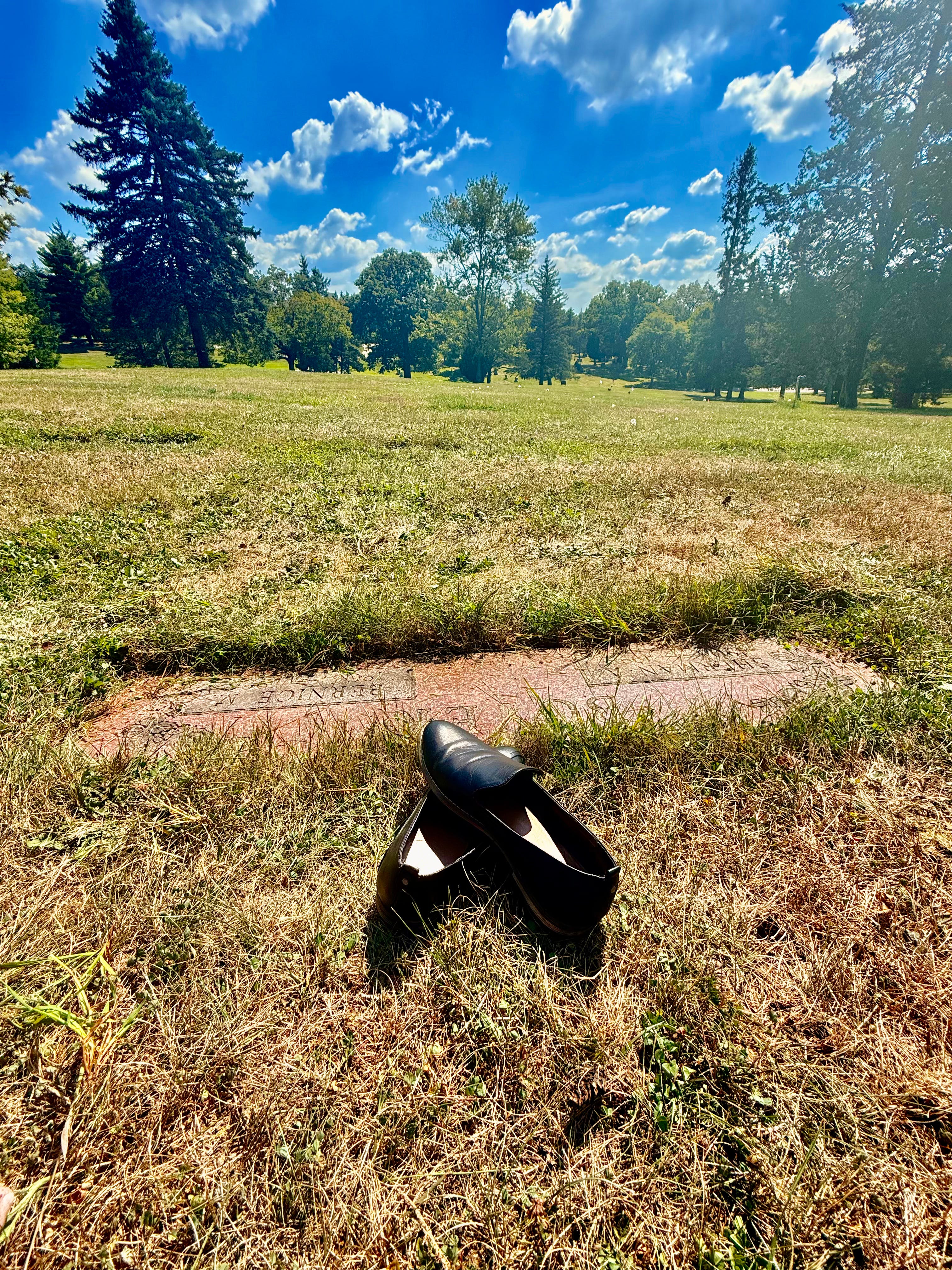
My great-grandparents are buried in Flint. I haven’t visited their graves in many years. I wasn’t sure I’d even remember where they were in a huge cemetery of rolling hills and fields of grass. Letting muscle memory steer the car, I stopped near a small section that looked vaguely familiar. I took my shoes off and started slowly wandering through rows and rows of headstones. Paying attention to not only the stones, but to the grass, the trees, the beautiful blue sky, the white puffy clouds, and the birds singing a chorus.
Not finding what I was looking for and thinking I was in the wrong section, and not wanting to be too late to the luncheon, I hesitatingly headed back to the car. Dragging my bare feet through the thick grass. My toes startled by the feel of a cool surface.
Pulling a few handfuls of overgrown grass, I saw their names. First my great-grandpa’s and then my great-grandma’s. I sat down beside them and continued pulling the grass covering them and wiping away the dirt. Once the stone was clear, I could just enjoy the visit. It’s been nearly thirty years since they died and the grief feels different, but sometimes still as fresh as newly cut grass on a really warm autumn afternoon.
I was 18 when my great-grandma died. So young and yet so aged by experience. I had learned years before her death that grief was bad and a sign of weakness. That showing any emotion, especially sadness and sorrow, was revealing vulnerabilities and a sure way to be hurt. When my great-grandpa died two years later, I was so numbed by depression and medications to treat it, that feeling any emotion, including grief, wasn’t really even possible.
Part of my healing from depression was learning to feel and express emotions. To name grief and speak about trauma. To change my belief that denying how I felt changed how I felt. If I don’t acknowledge the pain it cannot hurt me, right?
I’ve been reading Braiding Sweet Grass by Robin Wall Kimmerer. In one of the final chapters, she writes,
“Weep! Weep! calls a toad from the water’s edge. And I do. If grief can be a doorway to love, then let us all weep for the world we are breaking apart so we can love it back to wholeness again.”
I learned as a young student that grass is millions of years old and I’ve been learning all my life that grief too is timeless. And grief’s lessons are limitless, if and when we are willing to listen and be present. Present with ourselves, with others, and with grief itself. Present without judgement or agenda.
Grief cannot be prescribed. It cannot be forced or mandated. Real grief cannot be co-opted for political power or manipulated for personal gain. It cannot be refused or rushed. It cannot be easily defined or contained.
When I was ready to stand and leave the cemetery, I wondered what to do with the pieces and patches of grass I’d pulled from the headstone. Leave them? Take them? Toss them?
I held them, gently and loosely, like memories both good and bad. Like dreams both realized and unfulfilled. Like prayers both spoken and silent, answered and still seemingly unheard. Like tears both bitter and sweet.
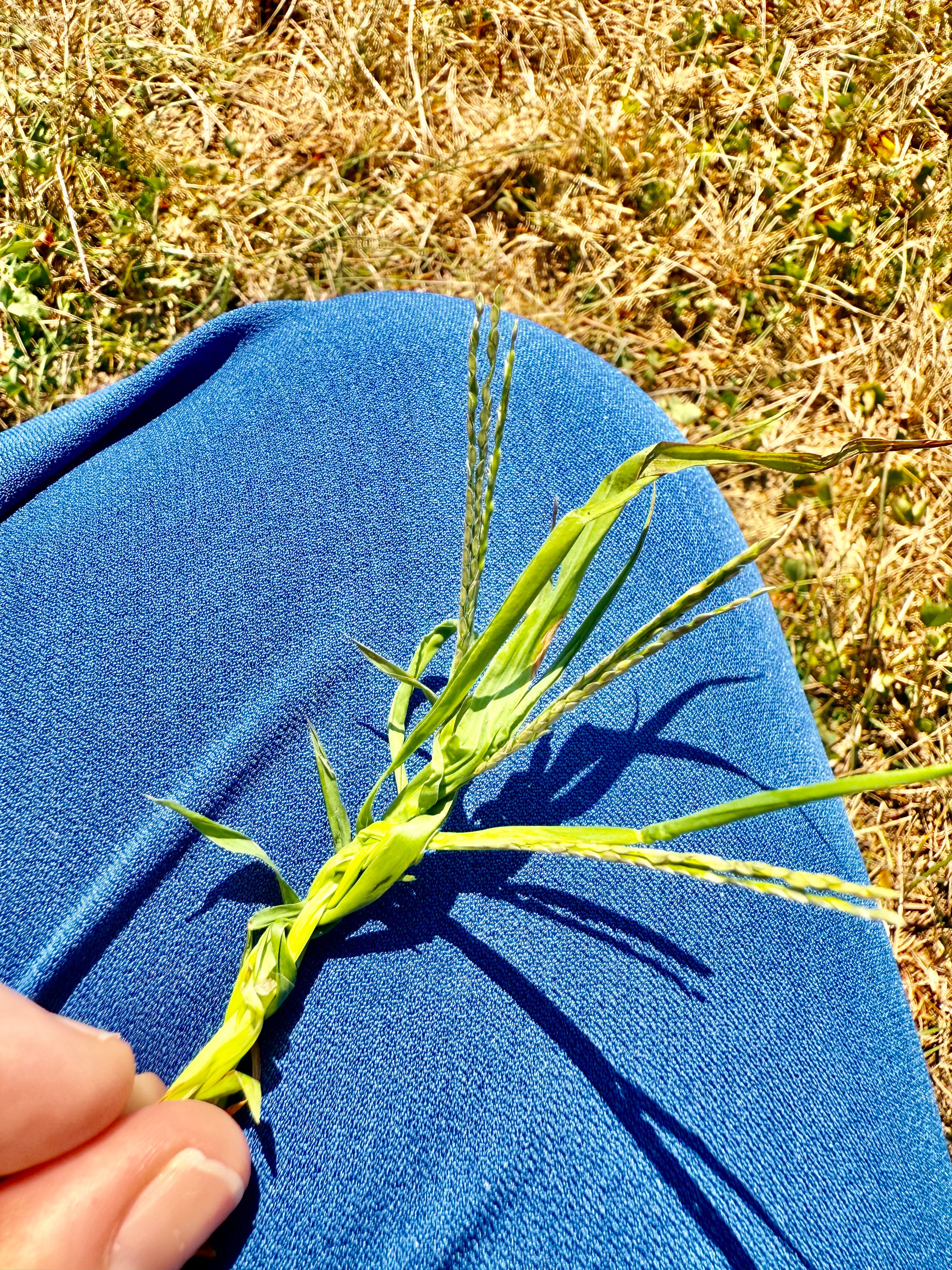
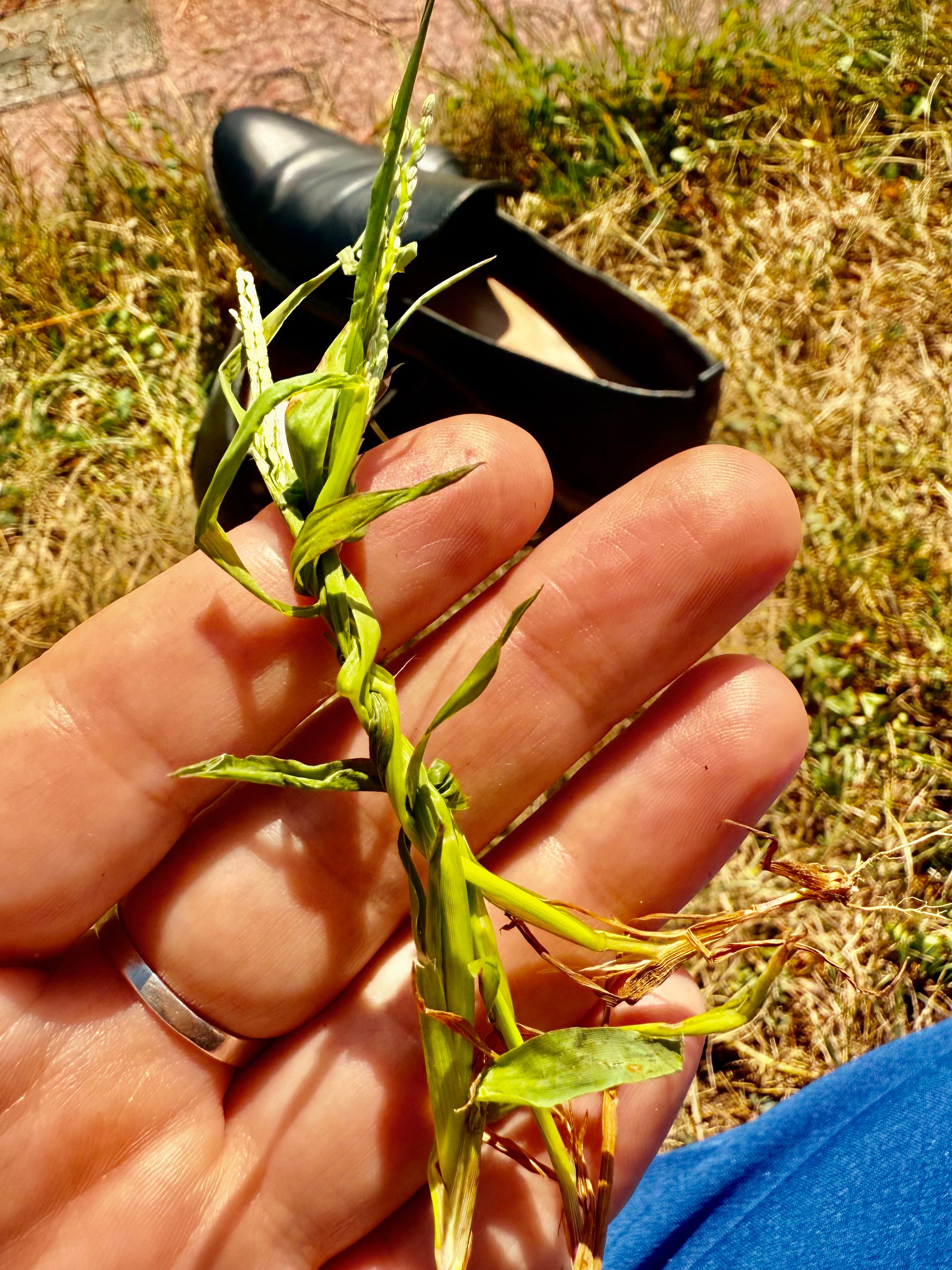
The blades were not of sweet grass, but they were undeniably sweet. Too small for my hands to braid, I twisted them together. A reminder of the ways our grieving lessens as we go on living. A reminder that some griefs are deeply personal and others intimately collective. That so much of our communal grieving is the result of our own actions and inactions. That the brokenness we grieve is a path to the wholeness we seek. That change begins with noticing a simple single blade of grass and being moved by its story to write one of our own.
I left the braided grass on the grave and added the single piece from my pocket to the pile. And headed to the luncheon, where I ate bread with ones I wasn’t sure I’d ever eat with again. We laughed and cried and reminisced. We were present with each other and and the grief that brought us to the table.
Water-fully Yours,
Rebecca & 10CAMELS
Leave a comment.
Share this post with a friend.
Become a free or paid subscriber.
Go Touch Grass!
Timely. Thank you. 🙏🏼
I’m so glad you listened to what you needed and stepped away from your phone for a bit. Our nervous systems were never meant to be so available to the awful things of the world 24/7. Sending so much care, compassion, and comfort for the grief you are navigating and the emotions moving through you.