

Thin Spaces, Hungry Hearts
who deserves to eat?

“Under the shadow of each other, people survive.” Irish Proverb
Samhain, the ancient Celtic festival marking the end of summer and the start of the new year is celebrated on or around November 1st. Celtic tradition divided the year into two seasons with the harvest being the transition from one to another. Samhain was a culmination of gathering the final harvest and preparing for the long cold winter ahead.
Celtic spirituality understood the division between this world and the other world to be at its thinnest during Samhain, allowing spirits to pass through. People honored their ancestors and wore costumes to ward off harmful spirits. Fire and food were an essential part of the festivities. The fire was used to prepare food for the living and the dead.
Soul cakes, biscuit-like treats made with sweet spices, were a symbol of remembrance, left out for the dead to feast upon. The poor, and especially children in the community, would go door to door offering prayers for the departed in exchange for a cake. Some believe this is the beginning of our Halloween trick or treat tradition.
This year in the United States children went door to door for trick or treating on the eve of the government’s decision to suspend food benefits for the month of November. Producing a division of harvest and hunger, a thin space between sustenance and starvation. I think of those people generations ago offering prayers as payment for food. I wonder about those today who will have to make sacrifices and come up with creative solutions to feed themselves and their families.
A few years back I was invited to preach at a church in my hometown. Several people in the congregation had once been members of the church where I grew up. After the worship service, this group who had known me my whole life, treated me to lunch. One of the men, a friend of my grandfather, began telling a story about an entitled woman, who had recently started attending the church. He said she was poor because she wanted to be and because it was easier to ask for things than to work for things.
I asked him if he remembered helping my family when I was a child. He, along with others in our church, used to pay for my sister and I to go to camp each summer and made sure we had groceries and school clothes when times were really tough. He answered, “You deserved it.”
Deserve is a loaded word. To be deserving is to be deemed worthy based on effort, achievement, or some other specific quality. In churches there is the question of who is worthy of God’s love, grace, mercy, forgiveness. In relation to communion, there is the question of who is worthy to come to the table. In my experience as a clergy person, there is the ongoing question of who is worthy to bless and distribute the bread and juice.
Much like the church, society sets policies and makes laws that further the categorization of deserving and undeserving, worthy and unworthy. With regard to healthcare, housing, education, employment, and food these categories uphold and perpetuate racism, sexism, ableism, nationalism, homophobia and transphobia.
Who deserves three meals a day? Who is worthy of a hot breakfast, a healthy lunch, a delicious dinner? Who deserves to freely shop the aisles of a grocery store? Who is only worthy of a pre-packed box of outdated items from a pantry? Who should just be lucky for a tray from the soup kitchen?
Last week I heard a pastor quote the Apostle Paul “if you don’t work, you shall not eat” to justify the anticipated cruel cuts to the Supplemental Nutrition Assistance Program (SNAP). According to USDA data, approximately 42 million people—1 in 8 Americans, receive SNAP benefits. Most SNAP recipients are children, people over the age of 60, and those with disabilities.
As is true for all biblical interpretations, context matters. This catchy one liner from 2 Thessalonians is part of a larger story. To spew it without any other explanation is reckless and dangerous. It is not a blanket judgement of anyone and everyone who isn’t working. It is referring to those in the community who are able to work and choose not to because they are so sure of Jesus’ second coming and their own salvation. Why work when the end is coming? Why be concerned about things of earth when heaven is on its way? Talk about a division of worlds and priorities!
A liberationist reading of this text invites us to consider the reasons why a person is not able to work. And in today’s society to engage in a critical analysis of why people who work are still unable to feed themselves and their families. Many SNAP recipients do in fact work, but their salaries are not sufficient to support the increasingly high cost of living and eating. We are taught to scorn the hungry, but not to question the systems that generate hunger.
Hunger is physical and spiritual. Hunger is not solely christian. Nor is it christian to enable and justify forced hunger and engineered famine. If those who profess faith in Jesus are to follow him, we must first acknowledge that hunger is individual AND systemic, and so too must be our efforts to eradicate it.
Let us feed our neighbors AND support community groups that are offering food and resources. AND let us dismantle ideologies that cause scarcity in a world where there is more than enough for everyone to eat. AND let us build tables where food is nourishment and sustenance not reward for those we deem worthy or blessings for those few we call deserving.

In 2014 I visited Ireland. A dream come true. A holy pilgrimage. An opportunity to learn history first hand, to connect with my ancestors, to walk where they lived, to meditate where they prayed, to dip my feet into the waters they waded, to hear the lyrical language they spoke, to read the poetry they sang, to breathe where they were born, to honor where they died.
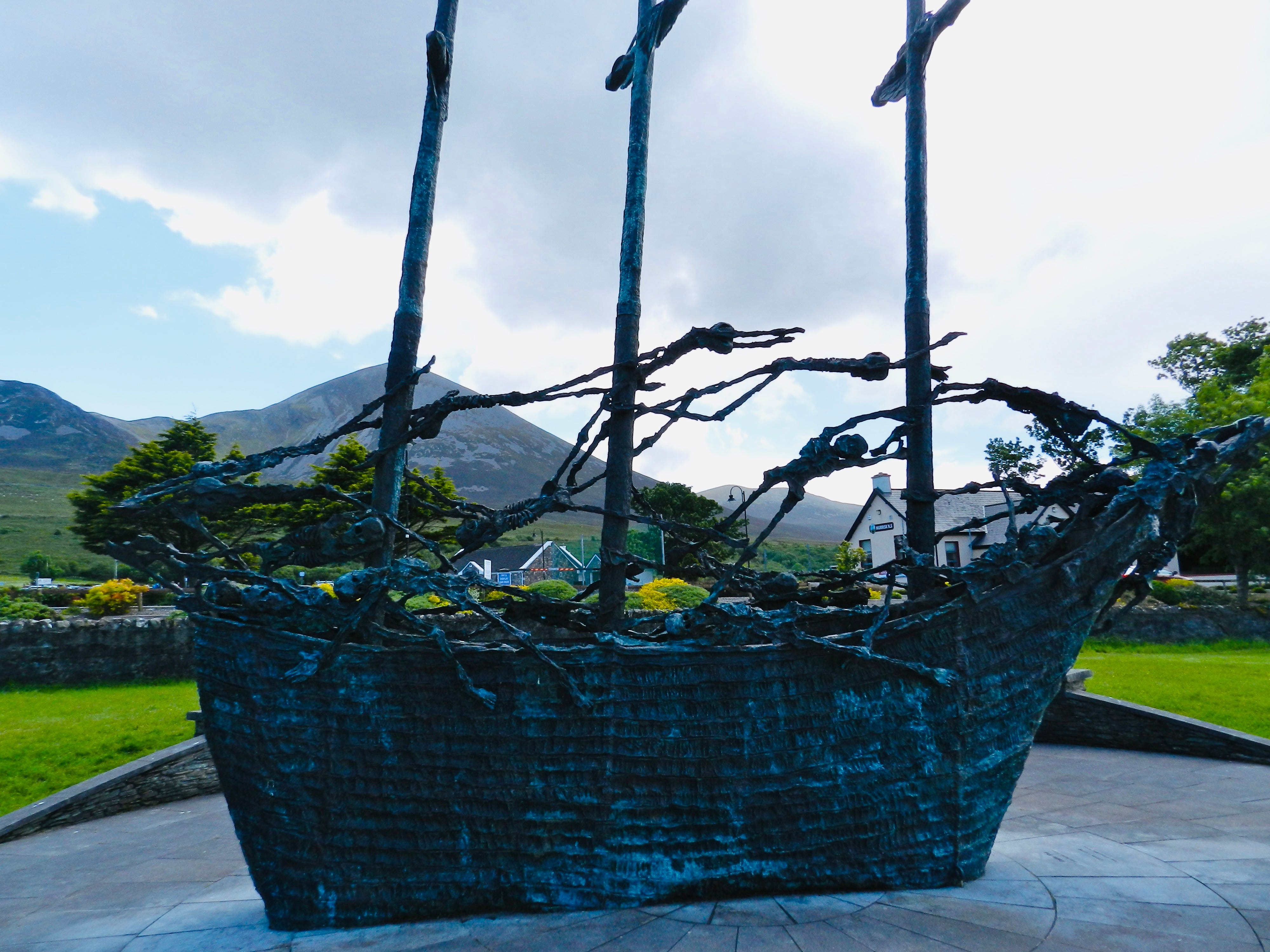
Growing up I heard accounts of the famine and how it propelled millions to emigrate from the land they loved. Visiting The National Famine Monument in the village of Murrisk, in County Mayo on Ireland’s Atlantic coast at the foot of Croagh Patrick, was a haunting encounter. The bronze sculpture is of a “coffin ship” crafted to symbolize the more than one million people who perished as a result of starvation and disease, many of whom died in those ships desperately attempting to escape hunger and find new life.
Sitting at the ship’s bow was an encounter with liminality. A thinning veil revealing ancient divisions. We divide years into seasons. Faith into factions. Religion into denominations. Spirituality into kinds. People into categories of worthy and unworthy, deserving and undeserving. Label food as delicacy and waste. Bread as fresh or discounted as day old. Consider hunger as holy or inhumane, depending on who is starving.
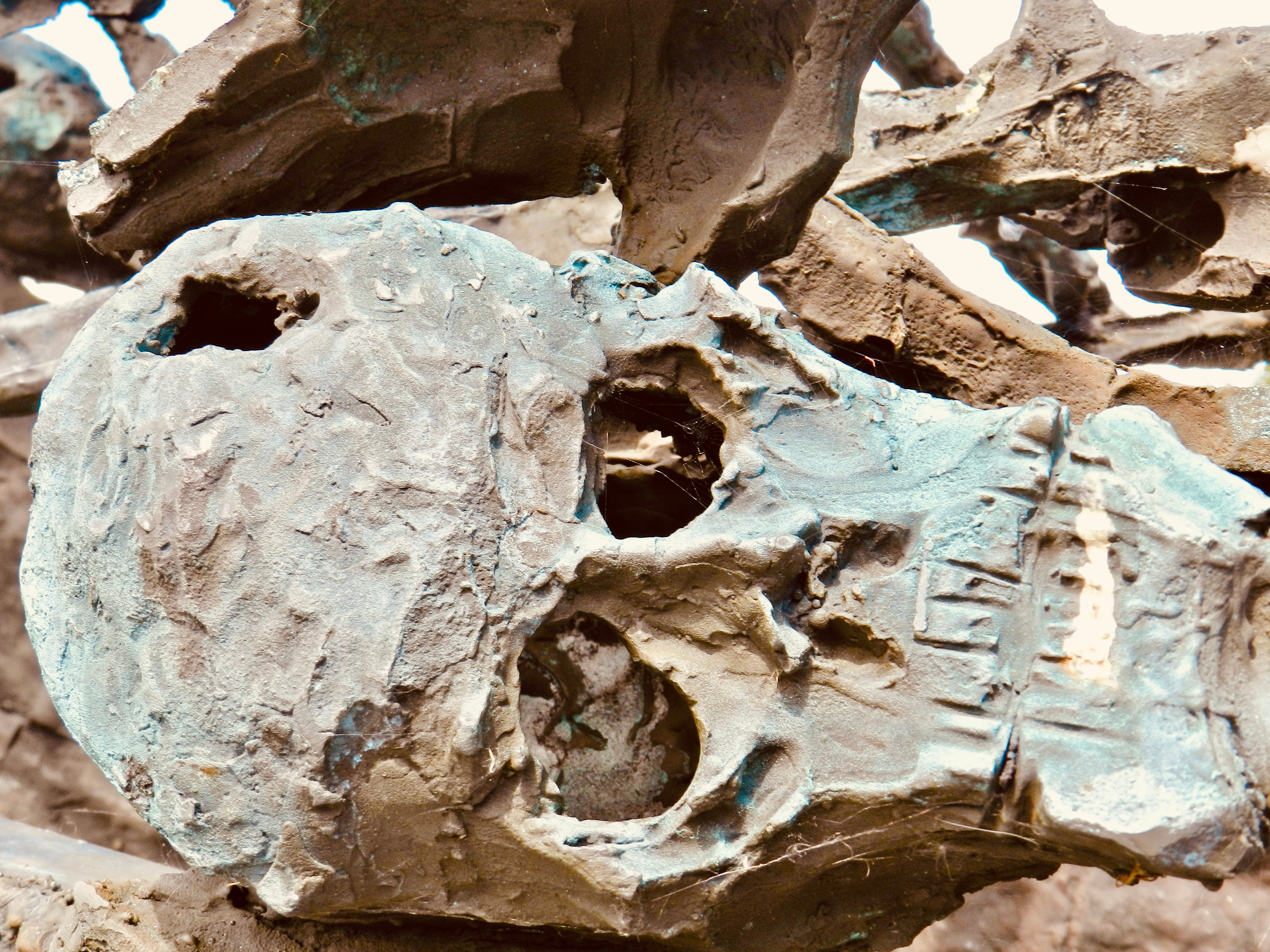
Humanity is in a collective thin space. Despair and hope lingering before us. Brushing gently against us like the frayed ends of frail quilt or fragile scarf. Will we give into despair or tend to hope? Will we permit it all to unravel or pick up a needle and start sewing it back together? Will we allow ourselves to be further divided or will we dare to explore new ways of connecting? Will we sit idle while our children and elders starve? Will we surrender our faith to those who force the poor to go door to door performing for the chance of receiving a piece of cake?
Summer is surely over. Autumn is fading. And for so many, in the United States and around the world, the cold pains of hunger have already begun. The rationing has started. The devastating consequences of starvation are visible. The death count is climbing.
We cannot stop winter from coming, but how we enter this season will impact us all. We can choose to go it alone or commit to turning shadows into shelter where people survive.
Water-fully Yours,
Rebecca & 10CAMELS
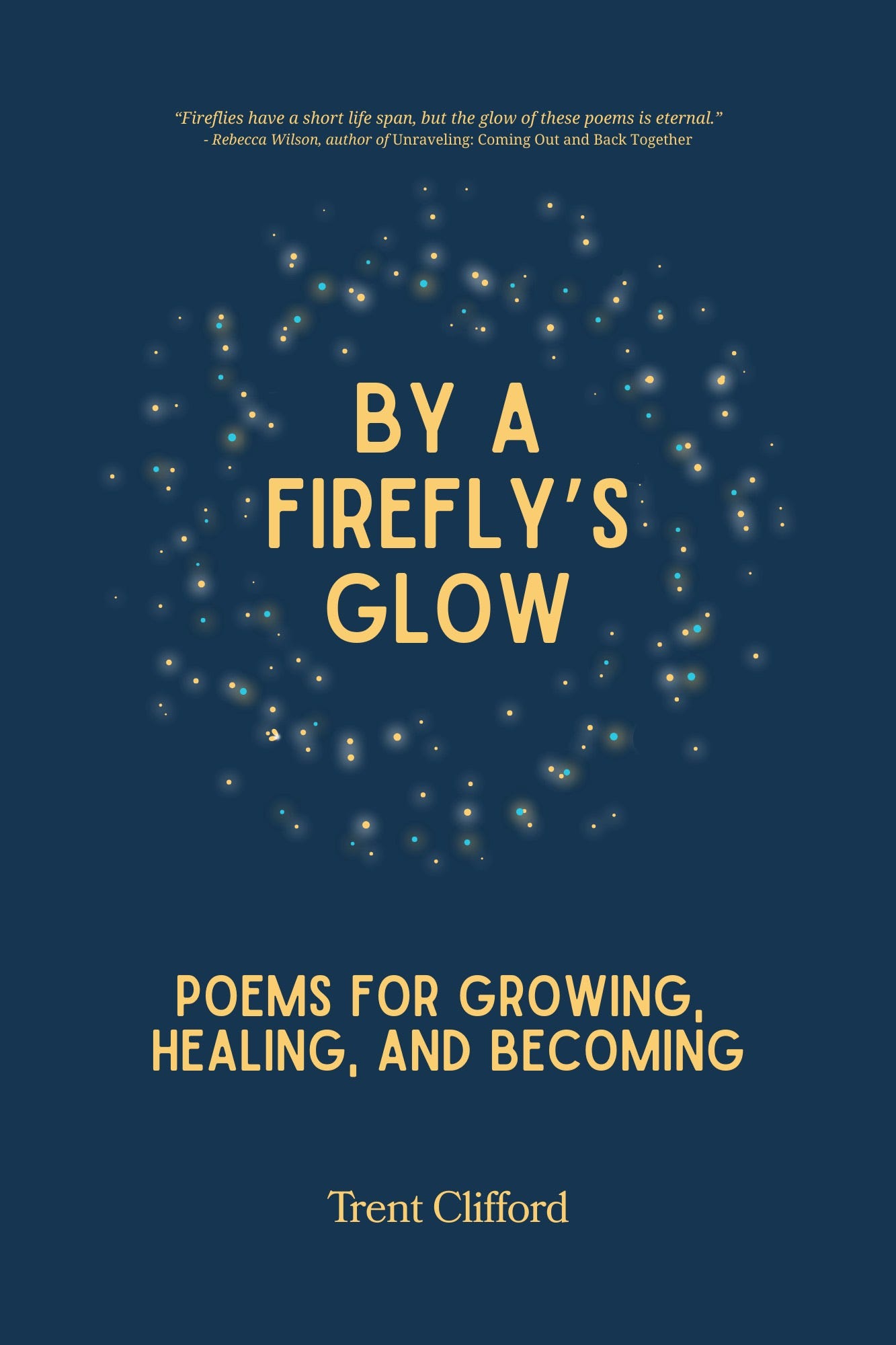
Next week while I am away at a writing retreat, my friend and amazing poet, Trent Clifford will be stirring the waters of Wednesdays at the Well. He has some imaginative words to share about growing, healing, and becoming. If you want to experience some of Trent’s creativity in advance, subscribe to his Substack Rewriting Faith and order his new book of poetry By a Firefly’s Glow—that I was honored to endorse.
Thank you for writing about this fundamental issue. Although far from having wealth I never missed a meal and I take that I will have food for granted.
What the administration is doing to people is criminal.
❤️🧡💛💚💙💜🤎🖤