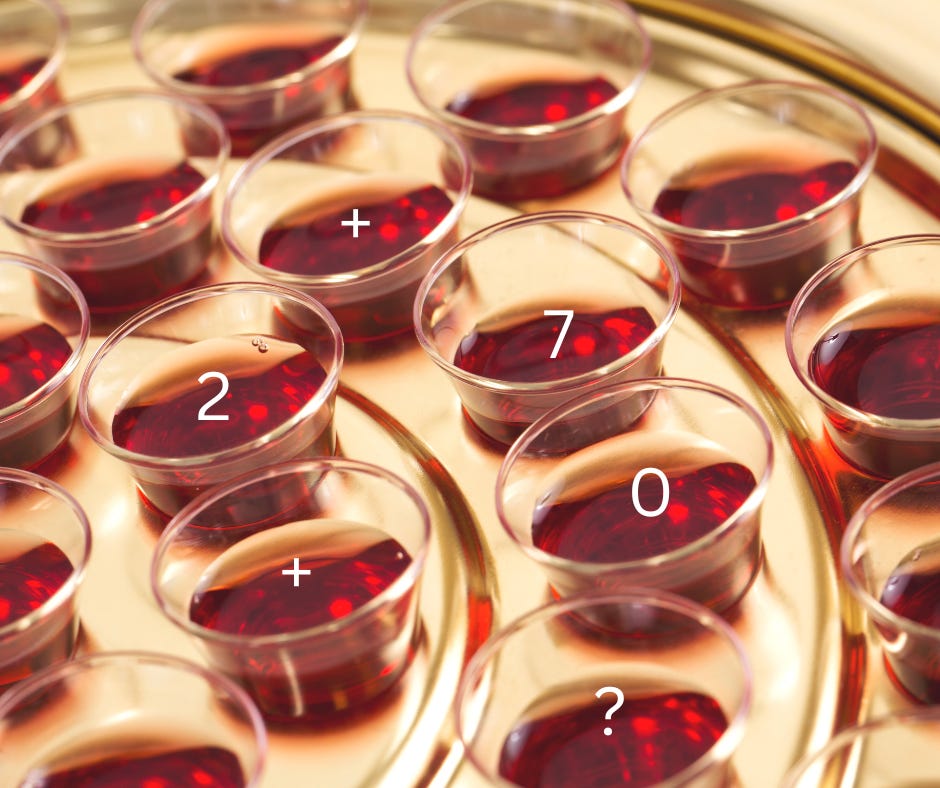
Sacramental Math: 2 + 7 + 0 = ?

2…
Of the two sacraments recognized by the United Methodist faith I inherited, communion more than baptism, caught my attention. I knew that the first Sunday of the month meant bread and juice. I anticipated it. The mood was different and the music too. The air lighter. The spirit softer. The crowd larger.
Behind the sanctuary was a little room I called the “communion kitchen” long before learning it was called the sacristy. There were no appliances, but cupboards and counters. Outside this room there was a pew, where if I sat in just the right spot, I had the perfect view.
Closing my eyes, I can still see Ms. Marva and Ms. Francis, two women of the church who religiously and devotedly tended to this space. Before worship, I watched them fill chalices and little glass cups with purple grape juice. I saw them place a loaf of bread on a golden plate and smaller torn pieces in baskets. Everything covered with perfectly ironed and pleated white cloths. After the service, I returned to my post to observe how they cleaned every item and took care of the leftovers. I was always worried about being seen. Would my inquisitiveness be reprimanded as nosiness?
One Sunday, Ms. Marva saw me. We locked eyes. I just knew I was trouble. She smiled and called me over with the circular motion of her pointer finger. In my hand she placed a few small pieces of bread and whispered “enjoy.”
I was probably 6 or 7, still years away from really understanding the healing or the harmful powers of communion. In that moment communion was simply a gift freely shared, that stirred my wanting to know more about god and the community around me.
7…
Going to Catholic Mass with my paternal grandparents felt like going on a field trip. The unknown was more fascinating than frightening. Familiar in a mysterious sense. I paid close attention to everything. The floor tiles, the art on the walls, the baptismal font at the back of the sanctuary, the large crucifix at the front, the bible and hymnals in the pew, the hymn numbers hung on a sign by the organ. I studied the way people genuflected before taking a seat, the way they made the sign of the cross, the way they knew the prayers and creeds by heart, the way they kneeled, and the way they received communion, which my grandma called the eucharist.
I was never explicitly told that I couldn’t go up for communion, but I knew that it was different in Catholic churches than in Methodist ones. As a child this didn’t upset me, it simply filled me with questions. Why was it different? Not just in who was served, but how people were served and how I could feel so strongly drawn to something that I wasn’t fully able to participate in?
One Sunday after Mass, I went back to my grandparents’ house for lunch. Having seen a confession booth on TV, I had a lot of questions. In the conversation I learned more about the act of confession and, how along with communion, it is one of the seven sacraments of the Catholic church.
More than the pastrami sandwiches we ate on sourdough bread, I remember pieces of those conversations. Communion wasn’t prescribed or performative. It wasn’t restricted or limited. It was listening and sharing. It was asking a bunch of questions and pondering possible answers. It was arriving hungry and leaving fed.
0…
I never imagined that taking communion would ever be a source of terror and fear. I wasn’t prepared when that moment came. I’ve shared in other reflections that I had a brief and yet profoundly impactful experience in a Pentecostal church. I first attended the summer after graduating high school. It was a very difficult and depressed time in my life.
This church is part of a denomination that does not recognize any sacraments. They consider water baptism and communion to be ordinances and commands. My whole life I’d understood sacraments as means of grace, ways of encountering god’s love and presence, and in one night that understanding was torn to shreds.
Communion was not a regular occurrence there and when it did happen, it was usually in the Sunday evening worship service. This particular night, the pastor lifted a cup of juice along with a piece of bread and began to yell. There was no invitation, only a stark warning. To drink from the cup without being confident of your salvation was a blasphemy. To eat the bread with any sin in your heart would bring eternal damnation. He went on to describe not only the fires of hell, but also the thoughts and behaviors that would lead one there. Many of those thoughts sounded like mine. Some of those behaviors mirrored mine.
I had two options. I could raise my hand and walk to the altar under watch of judgmental eyes, where I’d admit my failures and faults to angry men. Or I could keep silent and still risking my soul by taking the elements being passed down the aisle.
I chose option 3. I quickly rose from my seat and ran to the nearest exit. Soon realizing I couldn’t leave because I rode with someone else. My heart beating out of my chest, pulse racing, tears running down my face, I went into the bathroom and sat on an old flowered sofa in the corner.
I managed to calm myself, but I had no intention of returning to the service. 15 or 20 minutes later, I heard the door open and someone gently call my name. It was Bonita. A sweet woman, who along with her husband, had been extremely kind and caring since we’d met a few months prior.
She sat down next to me, intuitively knowing it was communion that caused me to run. She asked, “why don’t you want to take it?”
“Because” I admitted, “I don’t believe I am worthy.”
Bonita stayed with me until the service ended. As we walked into the lobby, met by her husband, she took my hand and said, “we’d like to invite you over to our home, to serve you communion. Will you come?”
With hope and hesitation, I accepted.
As I sat in a chair in their living room, assessing the room for danger and an escape route, she prepared a tray of crackers and cups of juice. Her husband offered a short prayer, and we ate and drank together. The night went on and so did the conversation and connection. They shared that until a few years before, they too had been lifelong members of the United Methodist Church.
It didn’t dawn on me then, but today it feels quite clear. Even though they changed from one church to another, their faith was still influenced by the one they’d left behind. Bonita extended welcome in a system of exclusion. Her presence called in love rather than fear. She offered grace when a preacher demanded judgement. She said I was worthy when others labeled me a sin. With Wheat Thins and Welch’s she served a message I’ll never forget.
2 + 7 + 0 = everything. Everything is grace.
What is your experience of grace?
How do you understand the sacraments?
Is communion an important part of your faith?
Can it only be found in church?
Tenderly, Rebecca
Section 4 of Not My Grandmother’s Hymnal: Composing a Curious Faith is titled Sacramental Supplements. The poems in this section, like today’s post, reflect the journey I’ve been on to know and name my personal understandings of grace, sacraments, and connection with god, goodness, creation, our neighbors and ourselves.
I am so close to reaching my pre-sale goal! I couldn’t do this without you. If you’ve already ordered, thank you! If not, there is still time. Pre-sales made before March 6th come with some special bonus gifts (including a book mark and a never before shared poem sent to your inbox on launch day). Click here to order now.